Prompts & Purpose · Edition 01
Beyond Profit: what four keynotes taught a Gen Z, AI-native entrepreneur
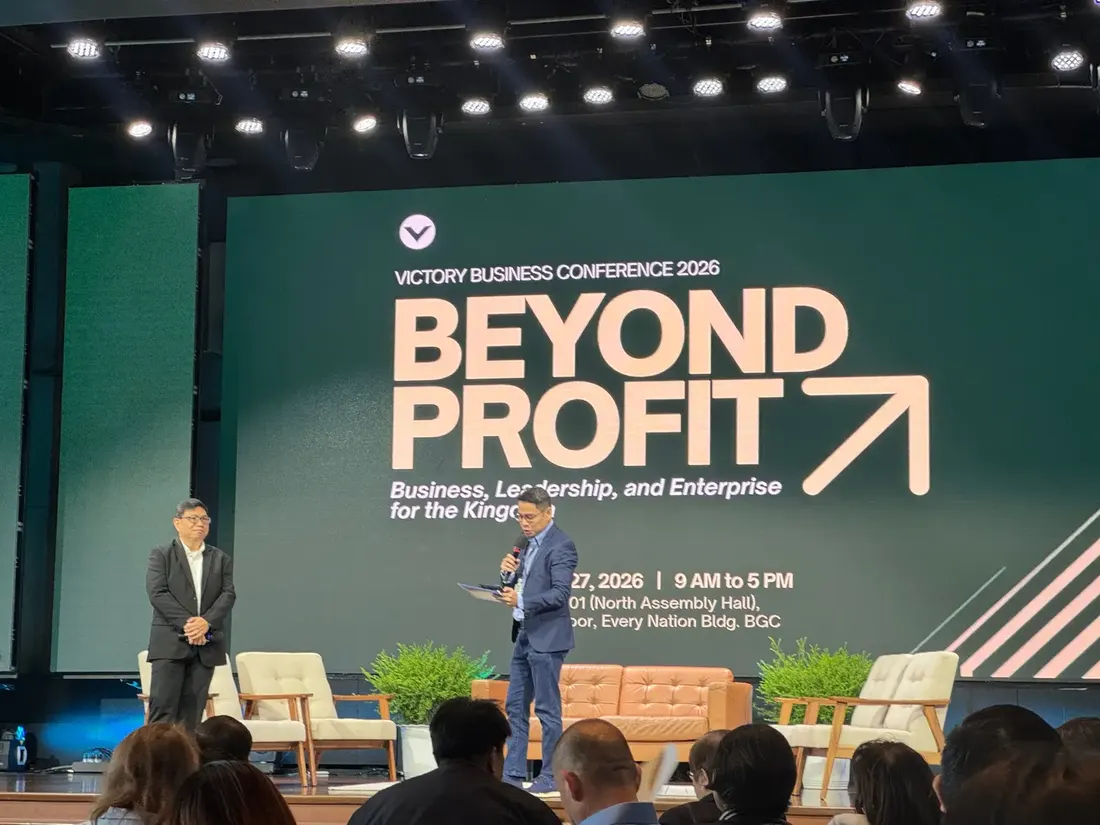
In brief: four speakers answered one question, what do you do with what you were given? Their answers were to hold your business in trust, build it here, keep it clean, lead the tools and go the last mile.
The question under every talk
I am a Gen Z faith-driven entrepreneur, and I build with AI every day.
So on Friday, 27 November, in a room full of business owners, I asked Meta’s head of public policy in the Philippines how to stop people from handing their thinking to AI. He did not name a single app. I will tell you what he said.
I was at the Victory Business Conference 2026 at Victory BGC. The theme was Beyond Profit: Business, Leadership, and Enterprise for the Kingdom. Nine to five: four keynotes and a panel of business owners.
I took notes in every session. When I laid them side by side, each speaker had answered the same question in a different field:
What do you do with what you were given?
Gio Tingson answered it for technology. Jim Ayala answered it for reach. Dr. Alvin Ang answered it for place. Randell Tiongson answered it for money.
This article is my notes on each talk, and what I am doing about it. I am 25. I co-own a steak business with my brother. I write AI playbooks for fellow Filipino assistants. And on my own time, I am building HABI, a hearing-care concept for Filipino families.
These are my own notes, made from a live transcript and my photos of the slides. Figures are as each speaker gave them on stage. Any mistake is mine.
1. Lead the tools: Gio Tingson on AI
Gio Tingson heads public policy for Meta in the Philippines. His keynote was called Beyond the Algorithm: building enterprises for human flourishing in the age of AI. His big idea fit in one line: the question is no longer whether AI is coming. It is whether we will steward it, or serve it.
The risk is a slow handover
He did not describe an AI war. He described something quieter. He cited a 2025 paper by Kulveit and colleagues called Gradual Disempowerment. The danger comes as convenience, then dependence, then the slow loss of human skill and of the checks that institutions give us.
Then he drew a line I keep coming back to. A tool serves you. An idol is served by you. A phone becomes an idol when we ask it for control, comfort or approval.
The slide I cannot stop thinking about
He showed a Wharton study by Steven Shaw and Gideon Nave. People solved puzzles with an AI helper. When the AI was right, they scored 25 points better than people working alone. When the AI was wrong, they scored 15 points worse.
The researchers call this cognitive surrender. You take the AI’s answer as your own, and you never notice the hand-off.
His hopeful line: surrender is a habit, and habits can be trained.
A fork in the road
Then he brought it home to the Philippines. He showed two roads for a country that competes on cost.
- Road one: same work, fewer people. AI automates the work we compete on, and our edge shrinks before we build a new one.
- Road two: better work, more capable people. AI frees Filipinos for judgment, better service and harder problems.
He told the story of Melanie Medrano, a chemist who founded the chocolate brand Cacaomistry. She found it hard to reach customers online. After some practical training, she used AI to tell her story and target her ads, and one campaign sold out a product. She still makes the chocolate. AI helped more people find it.
The question I asked
In the Q&A, I asked him: what is one habit owners can build in their people, so they lead AI instead of surrendering to it? I told him I write AI playbooks for fellow Filipino assistants, and that in church we build discernment through discipleship.
His answer: build friction on purpose, offline.
- Hold your all-hands face to face, even if Gen Z finds it uncomfortable.
- Learn that friction is good for us.
- Write down a specific list of the work that stays offline, then build that culture. Expect pushback.
He was talking about my generation. My instinct is to automate every step. He was telling me that some steps should stay slow.
Another owner asked how to measure success beyond revenue. His answer stayed with me too. Take your time back for God, family and rest. Do not fall into the trap of “AI saves me time, so I can do more work.”
What I am doing about it
- Keep a person on the final call. Every AI playbook I write has a check step: a human reads, decides and owns the result. As he put it: “No autonomy without accountability.”
- Write my offline list. Face-to-face reviews, and a written list of the work my teams keep human on purpose.
- In HABI, AI triages and clinicians decide. AI can help with screening and follow-up. A licensed professional makes every care decision.
- Spend saved time on purpose. The hours AI gives back go to family, rest and faith, not to more tasks.
The line I wrote down twice: “Discernment is built, not downloaded.”
2. Go the last mile: Jim Ayala on reach
Jim Ayala closed the day. Before he founded Hybrid Social Solutions in 2010, he was a director at McKinsey and later CEO of Ayala Land. His big idea: poverty is a problem of access. Build the whole last-mile chain, and make every part of it pay for itself.
Four quarters of a life
He opened with a slide that split his life into four quarters, each with its own values.
| Age | Role | Values | Goal |
|---|---|---|---|
| 0 to 20 | Student | Diploma values | Maximise education |
| 20 to 40 | Corporate executive | Résumé values | Maximise profit |
| 40 to 60 | Social entrepreneur | Eulogy values | Maximise impact |
| 60 to 80 | Kingdom entrepreneur | Judgment values | Maximise the kingdom |
His career advice: go to more funerals. Listen to what people say about those they loved. Nobody reads a résumé out loud.
He was honest about his own turning point. In 2022, a brother in his small group asked if he had ever shared the gospel with the people his company served. It had never crossed his mind. That year, he dedicated the company to Christ.
Susana’s lamp
Then he told the story that made him leave corporate life.
Mindoro, 2010. A mother named Susana had four children who studied by one kerosene lamp. She got a solar lamp. All four became honour students. At night, her husband used it to chase pests off their lanzones trees. The harvest went up, and he bought a motorcycle for the business.
Today all four children are college graduates. One finished magna cum laude.
Access, not ability
His line: people are poor because they lack access. They have the same abilities we do, but not the same opportunity. No power, no clean water, weak schools, little health care.
The lamp cost about $100. Nobody in that village could pay $100 at once. Almost anyone could pay about $2 a week, and the lamp saved them money on kerosene and phone charging from the first day.
The whole chain
A good product was never enough. He sells a full chain:
- Product: built for the market. Bright, waterproof, shock-proof, with USB charging.
- Demo: new technology must be shown before it is trusted.
- Loan: through faith-based microfinance partners, in small weekly payments.
- Delivery: across rivers and up mountains, then installed.
- Training: without it, people did not use the product well.
- Repair: anything that breaks is fixed within one week.
That last promise came from a question. A client was pleased that a repair took seven days. He asked his team why they were happy with seven days. Now one week is the promise, everywhere.
Hire for heart, then build the person
His typical new hire is a former tricycle driver with barely a high-school education. So he cannot hire on résumés. He looks for a servant’s heart, the drive to chase an impossible dream, and the toughness to work as a team in hard terrain.
One of his sellers grew up as a “convent boy.” He earned enough to change his parents’ home, was promoted to manager, and pitched a new hub in Cebu. He cried as he told the story. Before, when he was poor, nothing he said mattered. “Now you believe in me.”
He also told us the company gives 2% of its gross revenue every month, even in the years it lost money.
Why this one hit me
My Lolo raised me like a father. When the hearing in one ear almost left him, a hearing aid cost too much and broke too easily for a family like ours. He slowly slipped out of our conversations, one family gathering at a time. He did not lack ability. He lacked access.
I am 25. By Jim’s map, I am in my résumé quarter. Most of my LinkedIn is résumé. This article is me writing a little eulogy into it.
What I am doing about it
- Map HABI’s own last mile. Show, test, pay, fit, teach, fix. Every link, for hearing care, in places clinics do not reach.
- Explore microfinance partners. So families can pay for hearing care in small weekly amounts, the way they already pay for a lamp.
- Hire for heart, then train. Look for people who already serve their community, and give them a career path in hearing care.
- Set our giving rule early. Decide, before the first peso, what share of HABI’s revenue goes back to the community.
His closing slide quoted C.T. Studd: “Only one life, ’twill soon be past. Only what’s done for Christ will last.”
3. Build it here: Dr. Alvin Ang on place
Dr. Alvin Ang is an economist and professor at Ateneo. His big idea: the economy is at stall speed. Read the times, then act. You were assigned to this place, to create value for this nation.
A magazine he still keeps
On the day he began teaching in 1992, he bought a copy of Time magazine. The cover asked: “Can anyone fix the Philippines?” He still keeps it.
We were first
He reminded us how early we started. Asia’s first republic. Asia’s first airline. The oldest Chinatown and the oldest university. An LRT older than Singapore’s MRT. So what happened?
His answer: we chose to protect industries instead of making them compete. We built an economy that consumes but makes little, funded by remittances and BPO work. When he asked who in the room was in manufacturing, very few hands went up.
Vietnam
Thirty years ago, he saw war potholes on Vietnam’s roads. Last week, he was a guest of VinFast, and they showed him electric cars. Vietnam’s economy has now passed ours.
He also explained why the peso stays weak. Look at what you are wearing. Most of it is imported, and we need dollars to pay for it.
Stall speed
Picture a manual car climbing a hill in high gear. It loses power. You have to downshift. Our economy still grows, but it is slowing. Four forces feed each other: energy, interest rates, trust and food.
Then the part that hit the Gen Z in me. He said BPO work is exposed to AI, and voice work goes first. Services cannot be stored like goods, which keeps productivity low.
For many young Filipinos, a BPO seat is the first job.
Four tests before 2028
He listed the tests the country faces before the next election:
- El Niño: it comes slowly, then brings drought and lost food. Prepare early.
- Governance: the most important test, because it touches all the others.
- The budget and the election: watch the budget, and avoid anything that could put your business at risk near 2028.
- Energy: most of our power comes from coal, and coal prices follow oil. Diversify where you can.
On a new investment pact whose terms are not yet public, his advice was simple. Do not say no at once. Do not say yes at once. Know the details first.
Assigned here
He closed with the men of Issachar, who “understood the times and knew what to do” (1 Chronicles 12:32). His answer to that 1992 cover: God can. And our role as business people is to create value, and more than money value.
He said it plainly: “You are a Filipino, and you were assigned here, to create value for this nation.” About himself: “My assignment is to stay here.”
Why this one hit me
I grew up inside his question. My mother worked in Singapore for years so I could study here. For a lot of Filipino families, leaving is the default script.
But my generation has something his did not. Since I was 23, I have worked for US companies from Quezon City. Staying no longer has to mean thinking small. The global work can come to us.
What I am doing about it
- Build the jobs here. HABI will train and hire hearing-care workers at home, so fewer parents have to work abroad.
- Plan for a slow economy. Start lean, keep fixed costs low, and let families pay in small amounts instead of borrowing big.
- Make people the moat. Services cannot be stored. So HABI’s edge will be the skill of the people we train, not stock on a shelf.
- Move up from the script. To fellow Gen Z in BPO work: the safest work is the work that needs your judgment. Learn AI, then do what it cannot.
4. Hold it in trust: Randell Tiongson on money
Randell Tiongson opened the day. He spent years teaching Filipinos about money, and now serves in full-time ministry at Victory BGC. His big idea: your business is not yours. You hold it in trust for its Owner, and its goal is people who flourish.
Growth is slowing. Prices are not.
He started with what owners feel every day. Growth is slowing while prices rise. He called it one of the most dangerous mixes an economy can have.
Many owners have stopped asking “How do we grow?” They now ask “How do we stay open?” Online groups are full of restaurants and cafés selling their equipment. And raising prices is not an easy answer, because customers cannot afford it.
His response was Habakkuk 3:17–18. Even if the fig tree does not blossom and the fields yield no food, “yet I will rejoice in the Lord.” Joy does not depend on outside conditions.
Children of the Owner
He built the talk on three words: restoration, stewardship and flourishing.
The middle one changed how I see my own title. We are administrators, not owners. When there is trouble in the company, go back to the Boss and ask how He wants it solved.
After the talk, the host summed it up: “We are all COOs: Children of the Owner.”
Two economies
He said we live in two systems, and no one can serve two masters (Matthew 6:24).
| The world economy | The kingdom economy |
|---|---|
| Ownership | Stewardship |
| Career and identity | Calling |
| Profit | Purpose |
| Power and control | People |
Two of his lines I wrote down word for word:
- “You are not a business owner who happens to be a Christian on Sunday.”
- “God is not after your profit. He is after your heart.”
He was clear that profit is not the problem. Misalignment is. Use profit for the people you employ, your stakeholders, your community and missions.
Four bottom lines
From Brett Johnson’s book Repurposing Capital, he gave four bottom lines for a business: spiritual return, social impact, care for creation, and lasting financial health.
Then five steps to align a business:
- Rededicate the business. Give it back to God. It is never too late.
- Clarify its purpose. Know why it exists, beyond profit.
- Align its practices. Change the policies that do not fit.
- Build a discipleship culture. At work, in life, in the family.
- Measure by impact. Count people served, not only pesos.
Why this one hit me
I am a COO. I run a premium steak business with my brother, and in a slow economy, “How do we stay open?” is a real question. For two years, my job has been to run things well for executives. Randell was asking me to do the same for God.
After the talk, each table shared one takeaway. Mine was ikigai. When what you love, what you are good at, what the world needs and what it will pay for meet, the work stops feeling like work. Stewardship and flourishing follow from that.
What I am doing about it
- Rededicate HABI before launch. Before the first fitting, I will give the company back to its Owner, in writing, with my team.
- Put four bottom lines on one scorecard. Families who hear again, jobs created here, waste we avoid, and cash that keeps the clinics open.
- Treat profit as fuel. I will judge HABI by the families it brings back together. Profit keeps it running.
The whole day in five lines
There was one more session I cannot leave out. A panel of business owners spoke about integrity and regulators. Their advice: do not hide from regulators. Comply, stay open, and treat each visit as a chance to serve. One owner told us he gave up a large share of possible revenue to avoid a practice he could not accept. His company has now run for 28 years.
When I put all five sessions together, the day fit in five lines:
- Hold it in trust.
- Build it here.
- Keep it clean.
- Lead the tools.
- Go the last mile.
For HABI, that is now the plan: a business held in trust, built here, run clean, led by people, and taken the last mile to the families who need it.
My thanks to Randell Tiongson, Dr. Alvin Ang, the panel of business owners, Gio Tingson and Jim Ayala. And to Victory BGC for a day I will be building on for a long time.
One question for you: which of the five lines do you need most this year?
Sources
- Shaw and Nave, “Thinking: Fast, Slow, and Artificial” (SSRN, 2026)
- Gio Tingson as Meta Philippines head of public policy (Insider PH)
- Jim Ayala biography (Hystra)
- Vietnam’s GDP passes the Philippines (VietNamNet)
- Randell Tiongson profile
The lamp price, the weekly payment, the 2% giving rule and the 28 years are as the speakers said them on stage. I could not check them myself.